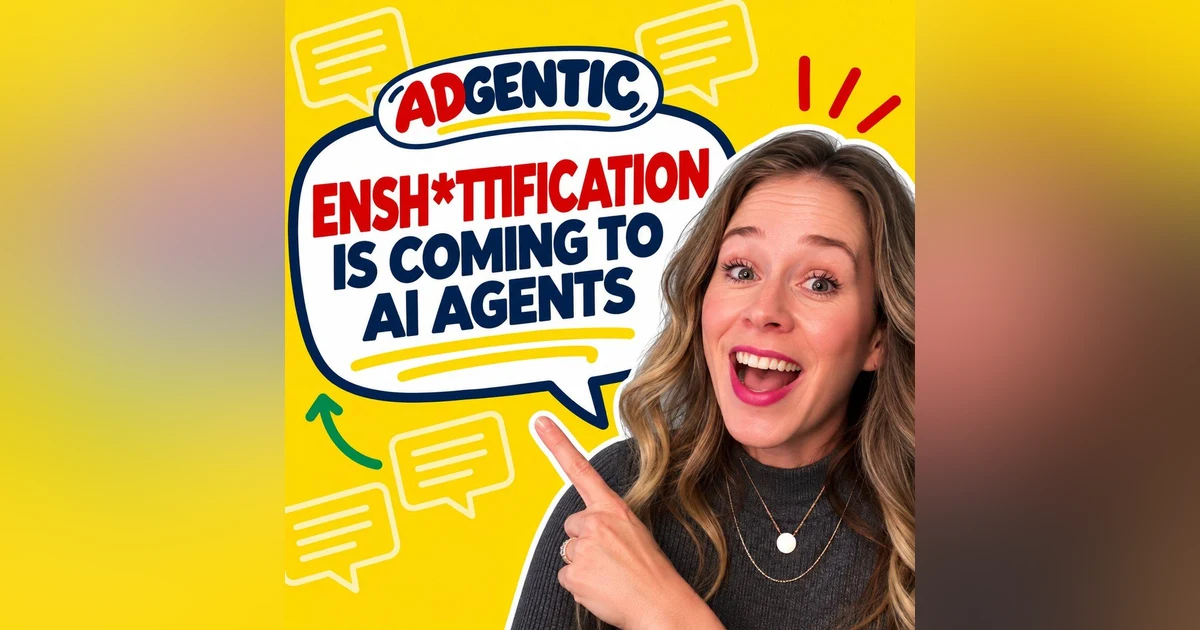
You May Also Enjoy: Ensh*ttification is coming to personal AI agents (from AdGentic)


 Overcast
 PocketCasts
 Amazon Music
 Audible
 Youtube Music
 RSS Feed
Bonus episode for Jason & Scot Show listeners: we're sharing an episode of AdGentic, another show in the ReFiBuy Media Network. If you've been following our retail media conversations, this one asks what happens when the ads move inside your AI agent. If you like it, subscribe to AdGentic for more.
Personal AI agents feel magical right now, and part of the magic is what's missing: ads. Kiri Masters walks through how Google, Facebook, WhatsApp and Amazon all started clean and ended up ad-funded, why AI is following the same script, and why that might not be the worst outcome. The real question isn't whether ads come to your agent. It's how bad they'll be.
In this episode:
→ The broken no-ads promises of Google, Facebook and WhatsApp
→ Ensh*ttification, and why ads are still the least-worst way to pay for consumer tech
→ Subscriptions vs fees vs ads, and why fees quietly turn into ads
→ What Meta's Muse, OpenAI's Dots and Instinct have said about making money
→ The ad formats starting to appear in AI, and the ones agents might borrow
Subscribe to AdGentic
- Substack: https://www.adgentic.ai/
- LinkedIn: https://www.linkedin.com/company/adgentic-podcast
- Podcast: https://adgentic.transistor.fm/
--
Join your hosts Jason "Retailgeek" Goldberg, Chief Commerce Strategy Officer at Publicis, and Scot Wingo, CEO of ReFiBuy.AI and Co-Founder of ChannelAdvisor as they discuss the latest news and trends in the world of e-commerce and digital shopper marketing.
0:01 Welcome to the Jason and scot Show, your source for the latest news and trends in the e-commerce industry. Featuring host Jason Retail Geek Goldberg, Chief Commerce Strategy Officer of Publicis, and scot Wingo, co-founder and CEO of ReFiBuy. Here are Jason and scot. Hey everybody, it is scot Wingo, the better half of the Jason and scot Show. In the last year, we have experienced a rapid rise of agendic commerce, this disrupted discovery, and I believe ultimately will work its way into the whole purchase funnel. There's been lots of innovations in agendic commerce, like the universal cart that just hit general availability out of Google Gemini, dynamically generated user experiences from ChatGPT just recently with GPT-6's release.
0:53 And in the last 40 days, new personal shopping agents like Muse and Instinct that are really capturing consumers' behavior and wallet. We've also had Chachpti start from zero and scale an ad business to a billion-dollar run rate faster than we have ever seen before. We also know that Amazon and Walmart are both exploring what advertising innovations around adjusted commerce, like sponsored prompts, would look like in their retailer shopping agents like Amazon AFS, previously known as Rufus, and Walmart Sparky. This intersection of agentic commerce, AI, the changing discovery landscape, and what that all means for traditional advertising models like retail media networks, and where this is all going, is a very interesting topic to every retailer and brand that I talk to.
1:50 It's also really interesting to us here as well. We think it's important enough and media enough to justify its own podcast. So today, we are excited to announce that we have partnered with none other than Curie Masters to launch a new podcast called AdGentic. A-D-G-E-N-T-I-C. AdGentic. AdGentic focuses on advertising in the age of AI. The first episode is out, and we thought you would enjoy checking it out because it is very similar to what a lot of topics we touch on lightly here at the Jason scot Show. If the topic is of interest to you and you enjoyed this first episode, be sure to subscribe to the audio in your favorite podcast app, the video on YouTube, and we also have a companion substack if you want to be notified when new things are put out, and it will have its own separate content as well.
2:45 You can get to all of this through our handy URL, which is adgentic.ai. Again, adgentic.ai. We hope you enjoy the first episode of Adgentic, and thanks for listening to the Jason and scot Show. Happy Adgentic Commercing. Look at this. A personal AI agent doing my busy work. No banners, no sponsored results, nothing for sale. Enjoy it, because it won't last. Ads are coming to personal AI agents. And in this video, I'll show you why and what those ads could look like.
3:32 Welcome to Adgentic, the series about advertising in the Adgentic era. I'm Kiri Masters, someone who has spent the last 10 years analyzing the retail media ecosystem. But now I'm captivated by this whole new era of advertising, ads in AI. Let's go. So like everyone else, it seems I recently got caught up in the euphoria of setting up my own personal AI agent and letting it loose on my busy work, email, scheduling, the usual stuff. And it was magical and at first I put that down to the thrill of getting these chores off of my plate but then it dawned on me, just how clean it all really was how dutiful the AI was it only seemed to have my best interests in mind and then I clocked it, part of that feeling came from what was missing, ads.
4:35 No clutter, no distractions, no reminder that somebody somewhere wants to sell me something. And I'm not the only one feeling it. Agents like Meta's Muse, OpenAI's Dots, and a startup called Instinct have all launched recently to a lot of love. But here's the thing. Every big consumer platform started out exactly like this. Let's start with Google. In 1998, its founders, Sergei and Larry, wrote the academic paper describing their search engine, and in an appendix, they warned that ad-funded search engines would be, quote, inherently biased towards the advertisers.
5:20 Two years later, Google launched AdWords, and at first, the ad sat off to the side, clearly separate. it. Today, of course, they sit at the top of the page with a tiny little sponsored label. Next up, Facebook. Now, Facebook skipped the no ads promise and went straight into treating ads as inevitable. Mark Zuckerberg on 60 Minutes back in 2008 said, there have to be ads either way, because we have to make money. He even pitched them as something of an upgrade for the consumer experience. Saying, what would you rather see, a banner ad from Bloomingdale's or that one of your friends bought a scarf?
6:03 Now, remember that scarf. We'll come back to it. And then there's WhatsApp. Co-founder Jan Coom kept this note on his desk from his co-founder, Brian Acton. Now, Facebook bought WhatsApp in 2014, and both founders were gone within four years. And in 2025, ads arrived in WhatsApp. Amazon is a slightly different story because it started as a store rather than a publisher or a media network. But in 2025, Amazon made almost $70 billion from its ad business. That is about double the profit from all of its web stores combined. The store is the content, the ads pay the bills.
6:46 And AI is already following the script. In 2024, Sam Altman called ads a last resort for OpenAI. But by early 2026, ChatGPT was showing ads to its free users. So that's the pattern, and it has a name. It's called enshittification. And yes, that is a swear word, but it is also in the dictionary. so it is a real word too. The writer Corey Doctorow first coined it back in 2022. His version goes, first, they are good to their users. And then step by step, the platform shifts the value to its advertisers and then to itself.
7:30 And so the word stuck, it was named word of the year by the American Dialect Society. And consumers stuck. Resent in shittification. Of course they do. But here's where I might lose some of you. Despite all of that, advertising is still the most elegant way we have to pay for consumer technology. Now, I am an advertising maximalist and I'm with Eric Sufort on this one. He says, digital advertising is the most positive sum economically expansionary technology summoned by humanity. So let's break it down. There are three main ways to pay for a consumer app.
8:14 The first is subscriptions. There's a flat price, whether you use it once a month or all day. Second is fees, a cut taken every time money changes hands, like the service fee on your food delivery. Three is ads. Now someone else pays because they want your attention. And look at how most consumer apps actually make money today. Mobile games, subscriptions, and or ads. Streaming TV, subscriptions and or ads. Booking.com, fees and ads.
8:56 DoorDash, fees and ads. E-commerce, increasingly ads. Social media, ads. Now, different types of users have different relationships with advertising and subscriptions. Subscriptions really work when a business is paying for that subscription, but consumers paying their own way are a different animal. So, how are today's consumer AI agents planning to make money? Well, Meta says that Muse will be free for a generous allowance and over time will profit by taking a small fee from transactions.
9:37 OpenAI launched Dots for paying subscribers only, but Sam Altman also said you should of course expect us to do a mass market product for billions of people someday. And OpenAI already runs ads in ChatGPT. And Instinct, while it's free, it has raised a billion dollars and it hasn't said anything about how it will make money. I guess they're planning on a wing and a prayer. Now, here is my problem with subscriptions and fees, especially for AI agents. It comes down to incentives. Subscriptions cap out at the people who are willing to pay, and most people won't.
10:21 When OpenAI announced ads, about 95% of ChatGPT's weekly users were on the free plant. Fees are a sneakier trap. A fee pays the agent every time you buy something. So now the agent has a reason to nudge you to buy something specific. And once merchants are competing for those sales, they will pay to get to the front of the line. Paying for a placement in front of a shopper, that's retail media. Now, fees. Fees have a way of turning into ads. As Casey Newton at Platformer put it, it will soon be some team's job to massively increase the number of transactions.
11:08 And notice Meta's language about how they're going to monetize profit from fees over time. So no one has really ruled anything out. And that's why I believe ads are coming to personal AI agents. The real question is, how shitty will it be? And this is where my eternal optimism kicks in. Maybe this time we don't need to repeat the mistakes of the past. Think about why ads annoy you. Usually it's one of two things. It's not relevant to me or it's getting in my way. Now remember the scarf. Plenty of us will begrudgingly admit that the ads on Instagram and TikTok are often, okay, sometimes actually helpful.
11:59 AI agent that really knows you has an even better shot at getting both of those things right. The right ad at the right moment in the conversation. So far though, ads in AI have been pretty uninspiring. ChatGPT's ads are a labelled box under the answer. Logo, headline, image, link. It's a search ad with a fresh coat of paint. We are starting to see some new ad formats developing that are native to AI. One is sponsored prompts, which Amazon pioneered. Another is sponsored agents, where users can have a conversation with an advertiser's AI agent.
12:44 And finally, OpenAI is testing its first visual ad format in ChatGPT, which appears while someone is waiting for an image to generate. But my prediction is that agents will more likely borrow from the formats that we already know. From retail media, sponsored picks in your agent's shortlist and offers on your order confirmation. From gaming, rewarded ads. Watch an ad, earn more free usage. From streaming TV and ad on the working on it screen while your agent books your flight. And here is the neatest one, not actually showing any ads at all.
13:29 Offsite advertising is where a retailer or another company with lots of user information allows advertisers to target their users on another platform like connect to TV or the open web or social media. And advertisers love it because they can target very precisely by behavior, by predicted behavior, by different customer groups. And now think of all of that behavioral insight that these chat assistants have about us. They know our hopes, our dreams, our ambitions. And with an off-site advertising program, these AI companies would never have to distract us with an ad or get in the way.
14:09 Now, the only catch is the margins of this type of advertising are typically lower because you have to share that ad spend around with more partners. And here's my personal wish list, which I'm sending off to AdSanta this Christmas. One is opt-in brand drops. Let me tell my agent which brands I want to hear from when they launch something new. Two is sponsored announcements I asked for. And three, ads matched to what I'm actually shopping for. I really think that with this depth of information that our AI assistants have about us, the ads could be better than we've ever seen them on other platforms.
14:49 Now, here's the one that everyone's worried about and what I think we need to be aware of and that is ads that quietly steer your agent. Paid rankings that you never see. A merchant paying to become your agent's default choice. That's what consumers already say that they are concerned about and that's where inshidification is a real issue. It's exactly the bias that Google's founders warned about back in 1998. That's why I think that ads that are shown to me that are relevant and clearly labeled are the best model that we've got. I don't think ads are abuse. One day we might look back and miss the clean, quiet experience of these early AI agents, but of all the options, ads are the least worst.
15:41 Thanks for tuning into Adgentic, the new show about advertising in consumer AI environments. Adgentic is part of the RefiBuy Media Network. I'm Kiri Masters, and I'll see you next time.